Learn from the basics of neural networks to revolutionary deep learning technologies with hands-on practice

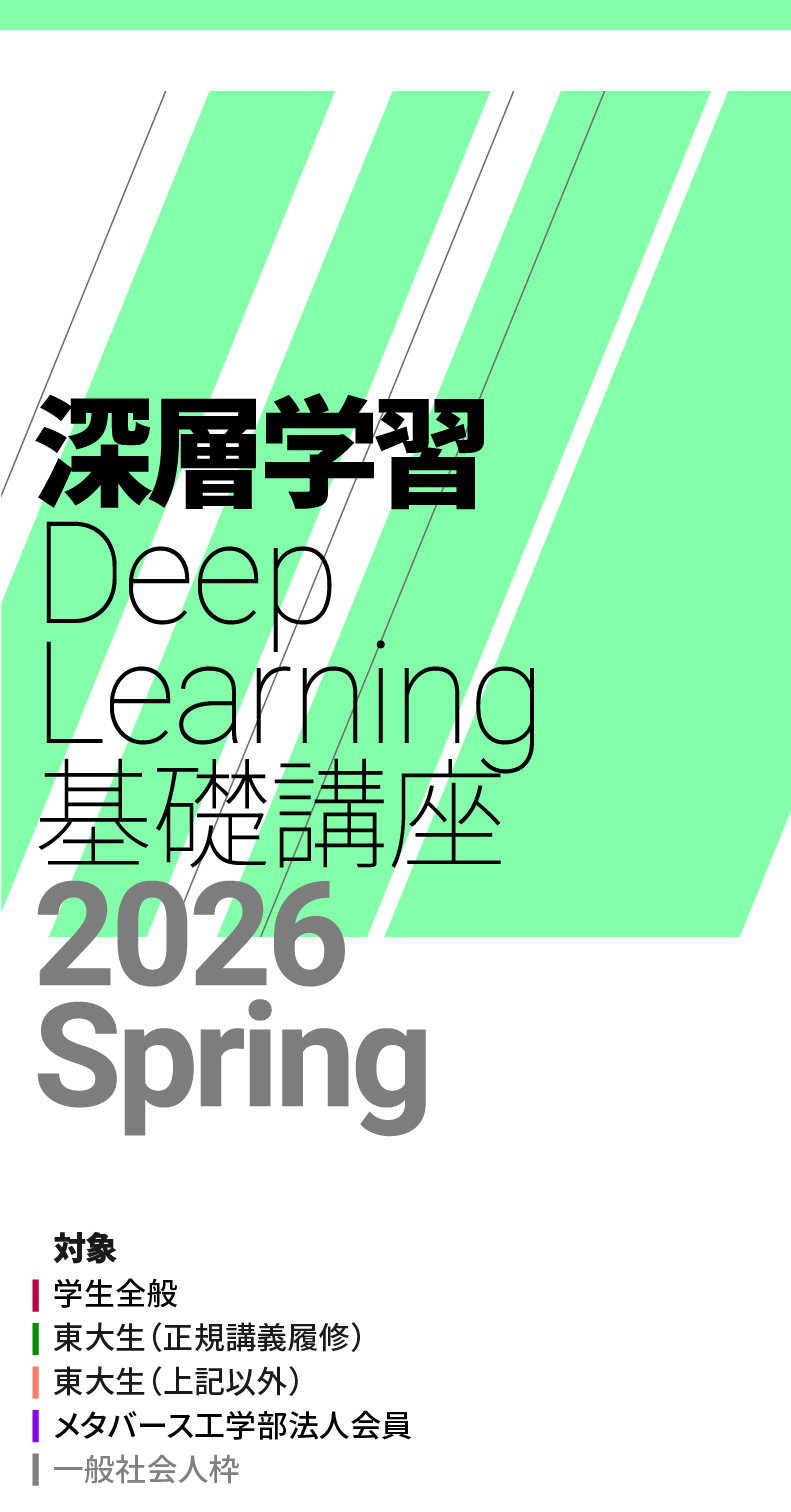
The “Basic Deep Learning” is an open lecture course hosted by the Matsuo-Iwasawa Lab, now in its 12th year. Starting with an explanation of neural networks, the course offers practical content that allows you to learn the basics of deep learning, from natural language processing to deep generative models. There is no need to set up your own environment, so you can easily participate from your own PC. Dive into the world of deep learning from the Matsuo-Iwasawa Lab at the University of Tokyo, the leading AI research lab in Japan!

Overview

Learn from the basics of neural networks to revolutionary deep learning technologies with hands-on practice

Starting with the basics of multilayer perceptron neural networks, the course provides step-by-step explanations about core technologies and the latest topics in Deep Learning. More than half of the sessions are hands-on exercises, aiming to help participants acquire practical skills. The course uses an environment that allows you to code in Python using GPU from your browser, eliminating the need to set up your own environment and allowing you to focus solely on the main topic.
The course will be delivered online, so you can attend from anywhere.
This course is a certified course for Deep Learning ENGINEER(“E資格”). Deep Learning for ENGINEER is a certification accredited by the Japan Deep Learning Association(JDLA). Once you have completed this course and met the specified requirements (such as studying supplementary materials), you will be eligible to sit for the Deep Learning ENGINEER exam. Click here for more details.

From this academic year onward, this course will be available in English.
(From this academic year onward, this course will be available in English.)

Benefits

  • 01

    Learn from the basics of Deep Learning to the latest technologies with hands-on practice

  • 02

    You can easily attend the course from your own PC

  • 03

    If you meet the requirements, you will be eligible to take the Deep Learning ENGINEER exam.(“E資格”)

Curriculum

Applications open: Late December 2025
Application Deadline: Saturday, January 31st, 10:00 AM
Notice of results: Early March (tentative)
Day: Every Thursday (There will be no class on May 7th and June 11th)
Time: 4:50 PM – 6:35 PM
Location: Online (Zoom)
Lecture dates, instructors, and content are subject to change.

Date and Time Instructor Curriculum
Session 1 Thursday, April 9, 2026,
16:50-18:35
Yutaka Matsuo Introduction to Artificial Intelligence and the Role of Deep Learning
Session 2 2026/4/16(木)
16:50〜18:35
Kawano Makoto
JEONG Seong Cheol
Fundamentals of Machine Learning
Session 3 2026/4/23
16:50〜18:35
Kobayashi Yuya
Ikeda Yuya
Fundamentals of Neural Network
Session 4 2026/4/30
16:50〜18:35
Taniguchi Shohei
Nobe Sensho
Optimization and Regularization in Neural Networks
Session 5 2026/5/14
16:50〜18:35
Oshima Yuta
Ichikawa Daiki
Convolutional Neural Networks
Session 6 2026/5/21
16:50〜18:35
Miyake Daiki
Ichikawa Daiki
Deep Learning and Image Recognition
Session 7 2026/5/28
16:50〜18:35
Nakano Akihiro
Iiyama Tomoshi
Recurrent Neural Networks and Sequential Data Processing
Session 8 2026/6/4
16:50〜18:35
Takashiro Shota
Ichikawa Daiki
Fundamentals of Transformer
Session 9 2026/6/18
16:50〜18:35
Kojima Takeshi
Nobe Sensho
Large Language Models and Natural Language Processing
Session 10 2026/6/25
16:50〜18:35
Iwasawa Yusuke
Takanami Ryosuke
Representation Learning and Self-Supervised Learning
Session 11 2026/7/2
16:50〜18:35
Imaizumi Satoshi Theory of Deep Learning
Session 12 2026/7/9
16:50〜18:35
Kitamura Toshinori Deep Reinforcement Learning
Session 13 2026/7/16
16:50〜18:35
Suzuki Masahiro
Nobe Sensho
Deep Generative Models

Our Team

Planning and Supervision

Matsuo Yutaka

Matsuo-Iwasawa Lab, Graduate School of Engineering, The University of Tokyo

Iwasawa Yusuke

Matsuo-Iwasawa Lab, Graduate School of Engineering, The University of Tokyo

Suzuki Masahiro

Matsuo-Iwasawa Lab, Graduate School of Engineering, The University of Tokyo

Instructors

Kawano Makoto

Matsuo-Iwasawa Lab, Graduate School of Engineering, The University of Tokyo

JEONG Seong Cheol

Matsuo-Iwasawa Lab, Graduate School of Engineering, The University of Tokyo

Kobayashi Yuya

Sony AI

Ikeda Yuya

Matsuo-Iwasawa Lab, Graduate School of Engineering, The University of Tokyo

Taniguchi Shohei

Matsuo-Iwasawa Lab, Graduate School of Engineering, The University of Tokyo

Nobe Sensho

Araya Inc.

Oshima Yuta

Matsuo-Iwasawa Lab, Graduate School of Engineering, The University of Tokyo

Ichikawa Daiki

Chiba Institute of Technology, Graduate school of Information and Computer Science

Miyake Daiki

Matsuo-Iwasawa Lab, Graduate School of Engineering, The University of Tokyo

Nakano Akihiro

Matsuo-Iwasawa Lab, Graduate School of Engineering, The University of Tokyo

Iiyama Tomoshi

Matsuo-Iwasawa Lab, Graduate School of Engineering, The University of Tokyo

Takashiro Shota

Matsuo-Iwasawa Lab, Graduate School of Engineering, The University of Tokyo

Kojima Takeshi

Matsuo-Iwasawa Lab, Graduate School of Engineering, The University of Tokyo

Takanami Ryosuke

Matsuo-Iwasawa Lab, Graduate School of Engineering, The University of Tokyo

Imaizumi Satoshi

Komaba Institute for Science, The University of Tokyo

Kitamura Toshinori

University of Alberta

Application

Eligibility

Students(Undergraduate / Graduate Student, students in junior college, professional training college, college of technology, high school and junior high school, working adult students)
*Applicants must be students currently enrolled in a degree-granting educational institution or accredited vocational school as of the start date (April 9, 2026), or have to prove that they plan to enroll. (Please attach a student ID or other certificates in the application form.)
*General working adults, non-matriculated students, and language school students, etc. are not eligible for this course.
*For applications from corporate members of the Metaverse School of Engineering, please check the information provided by your organization.
Please note that applicants requirements and all related announcements are subject to change without notice. Thank you for your understanding.

Requirements

– You are expected to study independently, stay motivated until the end of the course, and allocate at least 3 hours per week for self-study.
– You should have knowledge of linear algebra, calculus, probability, and statistics at undergraduate level and experience in numerical analysis with Python.
– You should have a basic understanding of machine learning (for reference, completion of the Global Consumer Intelligence (GCI) program is considered an entry level for this course.)
– Please refer to the self-study guide for “linear algebra,” “calculus,” “statistics,” etc., which are essential for understanding machine learning and deep learning(link).

How to attend the course

About the lectures
This course is offered free of charge. This is an online course that will be livestreamed from 16:50 to 18:35. It is also possible to follow the course by watching lecture videos that will be made available in the archive.

Completion Requirements
To complete this course, you must meet the following requirements:
1. Students are required to attend a minimum number of lectures(attendance can be registered by watching the recorded lectures within one week after each lecture).
2. Students must submit a minimum number of homework assignments within the deadline and receive a passing score.
3. Students must submit the final assignment by the deadline and achieve a passing score.
Special benefits will be given to outstanding students.
*Those who have previously taken the “Basic Deep Learning” course(including auditing students) are not eligible for the special benefits. This is a measure to ensure fairness, as past students had access to the study materials and homework. We appreciate your understanding.

Benefits for participants who successfully completed the course
・A certificate of completion (PDF) will be issued.
・We will provide information on events, study groups, and research projects related to data science and deep learning(specific participation conditions may apply).

[Important] For graduate students at the University of Tokyo who wish to register for the course

This course can be taken as a regular course at the Graduate School of the University of Tokyo by applying through the application form on Omnicampus and registering for the course on UTAS (this course is not available as a regular, credit-bearing course for undergraduate students of the University of Tokyo or students from other universities).

*Graduate students at the University of Tokyo who may register for this course in their study plans are requested to apply via the designated registration form.
*Credits will only be recognized for this course held in the S semester. (Registration as a regular course is not available for the course held in the A semester.)

[How to Apply]
Please follow the steps below to apply and register for the course.
(If you already have an Omnicampus ID, you may skip step (1).)

(1) How to register your ID from the Omnicampus ID Registration Page.
 1. Enter your school email address in the registration page.
 2. A URL for the ID registration form will be sent to your school email address.
 3. Enter the required information in the form and submit it. Your ID registration will be reviewed.
 4. After your ID registration is reviewed, you will receive a confirmation email.

(2) How to apply using the dedicated application form.
 1. Log in to your Omnicampus My Page and apply for the course.
   If you are a student at the University of Tokyo, a link to the course registration form will appear in a red pop-up window.
 2. Follow the link to apply using the dedicated application form.
 3. The application completion screen will be displayed, and you will receive a confirmation email.
 4. You will receive a detailed notification email.

(3) Course Registration via UTAS
 Complete your course registration via UTAS during the course registration period of your graduate school.
 *Course registration periods vary depending on your graduate school.

*If there is any possibility that you may register for this course for credit, please apply via the designated registration form.
*If you decide to withdraw from the course, please do not register for the course on UTAS. (If you have already registered, please change your registered information on UTAS.)
In this case, there is no need to notify our team. However, since your course history will remain, you will not gain special benefits for ourstanding students in the future.

IMPORTANT INFORMATION

Authorization for the Deep Learning ENGINEER Exam(“E資格”)
-The course does not guarantee the eligibility to sit for the Deep Learning ENGINEER E2026#2 exam (scheduled for August 2026).
・Eligibility for the Deep Learning ENGINEER Exam is limited to “students currently enrolled in a degree-granting educational institution or certified vocational school as of the start date (April 9, 2026), or those who can prove they plan to enroll.” (*In addition to completing the course, completion of supplementary classes is also required.) The current system may allow students who are not enrolled in such institutions to take this course. However, the acceptance for this course does not guarantee the authorization to take the Deep Learning ENGINEER exam.

Log in to Omnicampus
(For students or registered ID holders)

ID Registration Deadline│
Thursday, January 29, 2026 10:00 AM
Application Deadline│
Saturday, January 31, 2026 10:00 AM

*Please register your ID first, then apply for the course.
*If you are a graduate student at the University of Tokyo and wish to register for this course should follow the course registration deadline set by your graduate school, not the deadlines listed on this website.
*If you have already registered an ID, please log in to your My Page.
*For applications from a corporate member companies of the Metaverse School of Engineering, please refer to the information provided by your organization.
*We will not be reviewing applications during the New Year’s holiday period (from Saturday, December 27, 2025 to Sunday, January 4, 2026). Applications submitted during this period will be processed after the holiday.

FAQ

Q.What is the difference between this course and “Basic Deep Learning 2025 Autumn”?
A.
Curriculum: The lecture content and materials are expected to be the same as those for Autumn. Course registration: The Spring course is offered as a regular course at the University of Tokyo.
Q. Is there a fee to take the course?
A.
This course is free of charge.
Q. Can working adults take the course?
A.
This course is not open to the general public. If you are a corporate member of Metaverse School of Engineering, please check the information provided by your organization.
Q. I have classes or work during the lecture time and cannot attend the sessions. Can I still take this course?
A.
・In general, all lectures will be archived, so you can still take the course.
・If you watch the lecture and respond to the questionnaire by the attendance submission deadline (usually within one week of the lecture), your attendance will be counted.
・Please note, however, that certain lectures (such as lectures by external guests) may not be archived.
Q. Why can’t I proceed with the ID registration?
A.
Make sure all the required fields are completed. If there are any errors, the screen will not change and you will not be able to apply. Please check the following:

<For Students>

(1) For those registered with Gmail address: Do not enter an address with a domain other than @gmail.com (Please review if there is a half-width or full-width space after the email address).

(2) Expected graduation date: Graduates are not eligible for the course. Make sure you entered your graduation date correctly.

(3) Image of student ID or other proof of enrolment: Image files must be submitted in JPEG, JPG, or PNG format – TIFF format (iPhone images) is not accepted in our system. → Make sure you submit two images.

(4) Check the field of Terms of Use and Privacy Policy.

(5) Check the field “I am a full-time student” (for university students and working students, this applies to those who are eligible to obtain a bachelor’s degree).

(6)Review all fields are completed.

(7) Have you registered for a course on Omnicampus using the same email address before? → If so, please log in and apply via ENTRY [Log in to My Page (if you already have an ID)] at the top.

If your issue is not resolved after steps (1)-(7), please refresh the current page and re-enter your information.

Q. I didn’t receive the confirmation email for my ID registration.
A.
・Please check your spam folder.
・Please check to make sure that your email settings allow emails from <@weblab.t.u-tokyo.ac.jp> and <@mail.edu.omnicamp.us>. If you haven’t yet, please change the settings.
・If you have checked the above three and still do not receive the email, your email address may have been entered incorrectly. Please use the [Contact Form] (link). We will contact you to re-register your email.
Q. I didn’t receive an email with my application results.
A.
[Before the Notification of Application Results]
– The expected date for the Notification of the application results is listed on each course’s website. You will not receive results before this date.
– If you applied for multiple courses, notification dates may differ for each course.
[After the Notification Date]
– Please check the inbox of the email address you used when applying.

Other frequently asked questions can be found here (link).

Contact Form

※We do not accept course applications via the inquiry form.
※We do not accept applications after the application deadline.
※Please note that responses may take some time.

Application

Log in to Omnicampus
(For students or registered ID holders)

ID Registration Deadline│
Thursday, January 29, 2026 10:00 AM
Application Deadline│
Saturday, January 31, 2026 10:00 AM

*Please register your ID first, then apply for the course.
*If you are a graduate student at the University of Tokyo and wish to register for this course should follow the course registration deadline set by your graduate school, not the deadlines listed on this website.
*If you have already registered an ID, please log in to your My Page.
*For applications from a corporate member companies of the Metaverse School of Engineering, please refer to the information provided by your organization.
*We will not be reviewing applications during the New Year’s holiday period (from Saturday, December 27, 2025 to Sunday, January 4, 2026). Applications submitted during this period will be processed after the holiday.

For inquiries about joining our lab,
participating in internships, collaborative research, or media interviews,
please contact us through the information provided below.